The Brewers won on a third of the Dodgers' payroll. R&D budgets show why.
The Brewers won the World Series on about $129 million against the Dodgers' $396 million. A study of R&D budgets explains the pattern: a floor matters, the top does not.
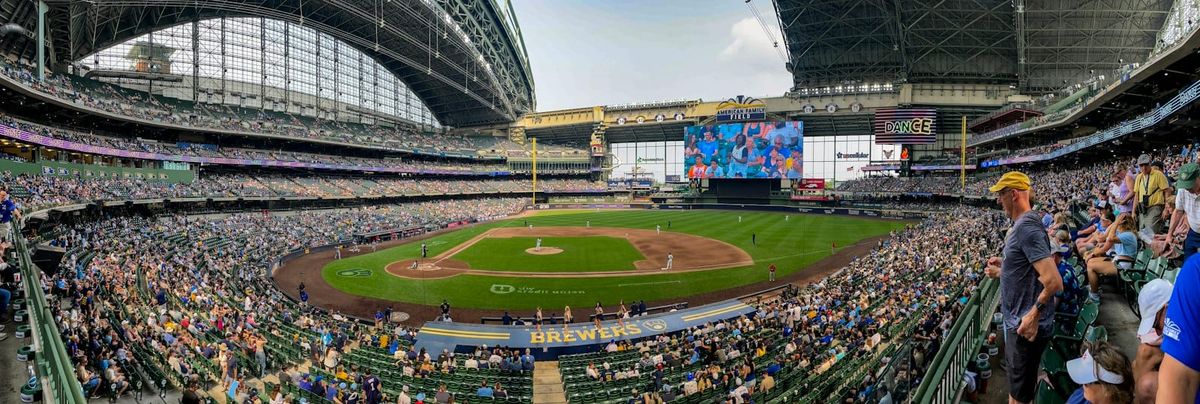
On 28 October the Milwaukee Brewers beat the Tampa Bay Rays in five games to win the first World Series in the club's history. Their 2026 payroll was about $129 million by Spotrac's count, around 20th of 30 teams. The Los Angeles Dodgers, whom the Brewers swept 4-0 to get there, spent about $396 million. So does money not matter in baseball? It matters, but not the way the spending debate assumes. A 2005 study of corporate R&D budgets found the same shape: spend too little and you fall behind, but above that floor, how much you spend predicts very little.
How much did the Brewers spend compared with the Dodgers?
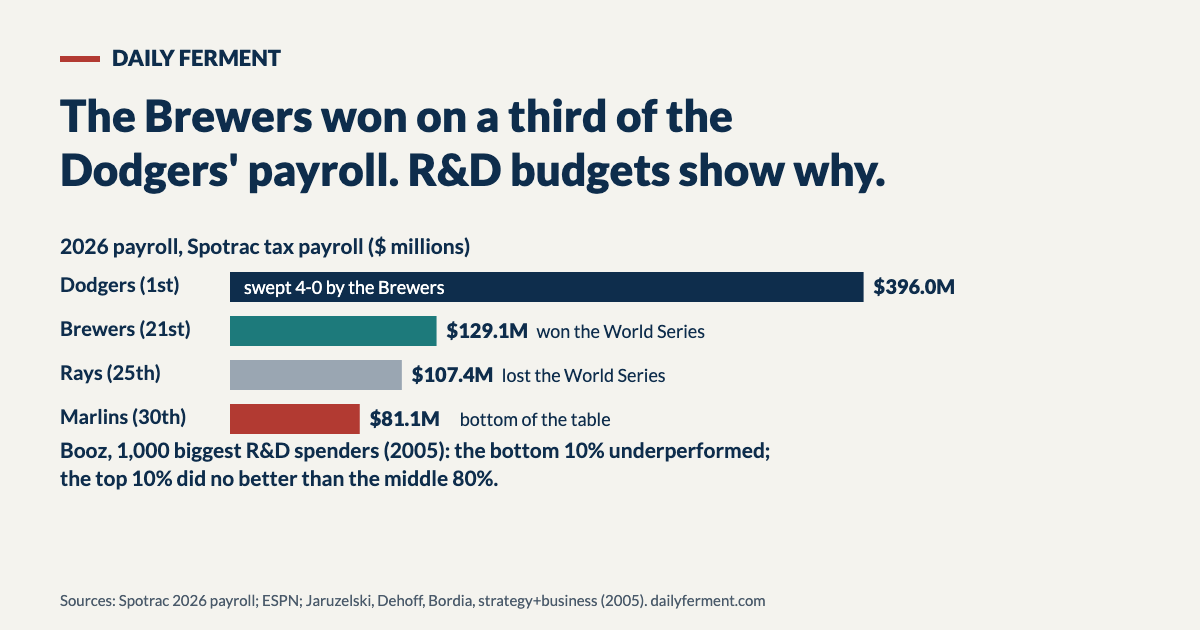
By Spotrac's tax payroll figures, the Dodgers were first at $396.0 million, the Brewers 21st at $129.1 million and the Rays 25th at $107.4 million. The lowest was the Miami Marlins at $81.1 million. Other counts put the Brewers a little higher: CBS Sports had them 19th by 40-man payroll, and the owner, Mark Attanasio, told ESPN they sit "around No. 19 or No. 20". Whichever count you use, they are in the middle, not at the bottom.
Sources: Spotrac 2026 payroll tracker; ESPN, 28 Oct 2026; CBS Sports, 23 Oct 2026; Wikipedia, 2026 World Series.
CBS Sports worked out that the two teams' combined payroll ranks were the lowest on record for any World Series, and their combined market size the smallest since 1985. CBS also lists the Brewers' market as 30th of 30 by Nielsen's ranking. And this wasn't a fluke run by a mediocre team. They won a franchise record 103 games, the best record in the majors, then went 11-2 in the postseason.
Guess first: from 1995 to 2022, how often did the team with baseball's best regular-season record go on to win the World Series?
7 times in 28 seasons, about one in four (Sports Illustrated count).
My first reaction: money doesn't buy titles
That was my easy conclusion. Then I checked how random October is. Sports Illustrated counted that from 1995 to 2022, the team with the best regular-season record won the World Series only 7 times in 28 seasons. Short playoff series are noisy even for great teams, so one title on its own proves very little about money.
But this time the best team did win, and it wasn't the richest. The more useful question is where the Brewers sat: not near the bottom, but in the middle of the payroll table. That detail is what made me think of a study from a completely different world.
What does R&D spending have to do with it?

In 2005 the consulting firm Booz Allen Hamilton looked at the 1,000 public companies that spent the most on research and development, and compared their spending with how they did. Barry Jaruzelski, Kevin Dehoff and Rakesh Bordia wrote up the result in strategy+business under the title "Money Isn't Everything". They found "no relationship between R&D spending and the primary measures of economic or corporate success, such as growth, enterprise profitability, and shareholder return."
The detail that matters is where the exception was. Companies in the top 10% of R&D intensity did no better than the middle 80% in any statistically significant way. The bottom 10% did worse, on gross margins, gross profit and shareholder returns. Jaruzelski put it plainly in a 2008 interview: in the bottom tenth of its peer group, a company's "performance was compromised", while being in the middle or the top tenth "had no real impact on performance."
Corporate R&D, Booz study (2005)
- Who: the 1,000 public companies spending most on R&D
- Bottom 10%: underperformed on gross margins, gross profit and shareholder returns
- Top 10% vs middle 80%: no statistically significant difference
- Reading: below a floor money matters; above it, how it is spent
MLB payrolls (2026)
- Bottom: Marlins, $81.1 million, 30th
- Middle: Brewers, $129.1 million, 21st: best record and the title
- Top: Dodgers, $396.0 million, 1st: swept by the Brewers
- What decided it (reported): talent identification, development and trades (CBS Sports)
Sources: Jaruzelski, Dehoff, Bordia, strategy+business, 2005; Spotrac; ESPN; CBS Sports.
The pattern lines up with this World Series. The Marlins at the bottom of the payroll table are the bottom-decile R&D company: too little money really does hurt. The Brewers, Rays and Dodgers are all above the floor, and above it the money stopped deciding. What decided it, by every account I read, was what the clubs did with what they had. CBS Sports called the Brewers and Rays "among the very best at identifying and developing talent" and said trades had "done the heavy lifting". Attanasio's own phrase is "punch above our weight".
I've seen the same idea in a piece I wrote about the UK's non-compete curbs and what Bosman did to football contracts: the rules about money change behaviour less than people expect, and the clever teams move to wherever the advantage still is. And it's close to the argument in why AI hasn't paid off outside tech yet: spending is not the same as capability.
Does this settle the salary cap fight?
No, but it points at which half of it the evidence supports. Baseball's labor agreement expires at the start of December. MLB Trade Rumors reported that the league is expected to push for a salary cap together with a salary floor, and that the players' association has long opposed a cap because it limits what players can earn. Each side can read the Brewers its own way: as proof the current system already lets small clubs win, or as one title that doesn't change the averages.
My own view, and it's only my view: the R&D evidence says the floor is the part with teeth. If spending below a certain level costs you, a floor protects fans of the clubs that sit there. A cap limits spending at the top, which is exactly where the Booz study found spending made the least difference.
What would change my mind: a study of baseball payrolls showing that, above the bottom few teams, more payroll still predicts more wins over several seasons. One World Series can't show that either way, and the Booz data is about companies in 2004, not ball clubs.
How sure am I?
- Established
- The payrolls (Spotrac), the results (ESPN), and the Booz finding that bottom-decile R&D spenders underperformed while the top decile did no better than the middle.
- Inferred
- That the R&D pattern fits baseball payrolls. One season is one data point, and the Booz data is about companies in 2004.
- Still a guess
- That a salary floor would do more for competition than a cap. That is my view, and nothing here tests it.
Spending matters most where it is missing: below a floor it costs you, and above it, what you do with the money decides more than how much of it there is.
More on Daily Ferment: Microsoft offered 60,000 people the same exit. Who takes it? and Accenture capped Claude at $29 a month. The rest now bills like photocopying.
Sources
- Bradford Doolittle, "World Series champs, at last! Milwaukee Brewers barrel their way to the top", ESPN, 28 October 2026. espn.com
- Dayn Perry, "How the Rays and Brewers were made: 2026 World Series foes linked by roster-building philosophies", CBS Sports, 23 October 2026. cbssports.com
- Spotrac, "MLB Team Payroll Tracker 2026" (tax payroll). spotrac.com
- Wikipedia, "2026 World Series" (playoff path). en.wikipedia.org
- Will Moon, "The best record in baseball and winning the World Series: a history", Sports Illustrated, 31 August 2023. si.com
- Barry Jaruzelski, Kevin Dehoff and Rakesh Bordia, "Money Isn't Everything", strategy+business, 29 November 2005. strategy-business.com
- Amy Bernstein, "Making Innovation Strategy Succeed" (interview with Barry Jaruzelski), strategy+business, 8 January 2008. strategy-business.com
- Darragh McDonald, "MLB, MLBPA Begin CBA Negotiations", MLB Trade Rumors, 12 May 2026. mlbtraderumors.com