Microsoft offered 60,000 people the same exit. Who takes it?
Microsoft's new buyout pays everyone by the same formula, set by tenure and level. Research on past buyouts, and the airline seat auction, show why that decides who leaves.
On Monday, 26 October 2026, Microsoft offered a voluntary buyout to about 60,000 employees, roughly a quarter of its 223,000 staff, in participating teams in the US, Canada, the UK and India. The offer runs until the first week of December. It pays standard severance, scaled by tenure and level. Performance plays no part, and there is no age or tenure floor.
So who takes it? The short answer from the research on past buyouts: whoever the price suits, and the company only gets the leavers it wants when the price, or a veto, tracks what each person is worth to it. This one tracks tenure and level, and that choice matters more than the headline number.
What exactly is on the table?
The memo from Amy Coleman, Microsoft's chief people officer, as reported by GeekWire, calls it "a new choice" for employees "who may be considering a future outside the company". Eligibility goes up to level 70, which includes general managers and some vice presidents, but not corporate vice presidents. The package is base pay set by tenure and level, continued stock vesting, healthcare for a fixed period and career transition help. Business leaders decided whether their groups take part at all: sales is out, and so are some engineering and corporate teams.
Guess first: of about 8,750 people offered Microsoft's spring retirement deal, what share took it?
About 30%, roughly 2,600 people, at a $900 million charge. Microsoft says it expects a much smaller share this time. Source: GeekWire, 26 Oct 2026.
It is the second exit scheme this year. The spring Voluntary Retirement Program, the first in Microsoft's history, went to about 8,750 US employees whose age plus years of service crossed a threshold. About 30% took it, which is around 2,600 people, and it cost a $900 million charge. Then came 4,800 layoffs in July, about 2% of staff, as Axios also reports. Microsoft says it expects a much smaller share to accept this time, and gave no number.
Sources: GeekWire and Axios, 26 Oct 2026, reporting Microsoft's memo. 60,000 of 223,000 is 27%.
- April 2026 First Voluntary Retirement Program: about 8,750 US staff eligible, about 30% accept
- July 2026 4,800 layoffs, about 2% of staff
- 26 Oct 2026 Voluntary exit offer to about 60,000 people
- 28 Oct 2026 Quarterly earnings, which may show the expected cost
- First week of December Deadline to accept; leavers go at the end of the year
Sources: GeekWire and Axios, 26 Oct 2026.
My first reaction: the best people leave
That was my first thought, and it is the line I kept seeing in the posts on page one of Google on 27 October: give everyone the same cheque and the people with the best options walk out with it. It sounds right. I wanted to see whether anyone had measured it.
Two studies, with opposite answers.
Tsuyoshi Tsuru (2005) used personnel records from a Japanese firm that ran two buyout rounds. In the 1993 round the people who took the offer had performance ratings no better than those who stayed, and worse than people who quit on their own; the paper reads them as the people the company wanted to let go. In the 1996 round it was different for lower graded staff: the takers there rated higher than those who stayed, about as well as voluntary quitters. Capable people left. Tsuru's conclusion is the useful part: the company could decide whom to dismiss, but it could not control who accepted a buyout, even with schemes meant to keep valued staff.
Kenneth Whelan, Ronald Ehrenberg, Kevin Hallock and Ronald Seeber (2011) studied Cornell University's Staff Retirement Incentive, offered to staff aged 55 or more with at least 10 years of service. About a third accepted. Those with lower pay relative to similar colleagues, their stand-in for productivity, were more likely to go. Their verdict: adverse selection "was not a problem" there.
So my first reaction was half right. It depends on who the offer reaches and how the money is set. Cornell's offer went to people aged 55 and over, for whom the question was when to retire. Tsuru's second round reached lower graded staff with careers still ahead of them, whose outside options were real.
Where airlines got this right
The cleanest working example of a voluntary exit is not in HR at all. It is the overbooked flight.

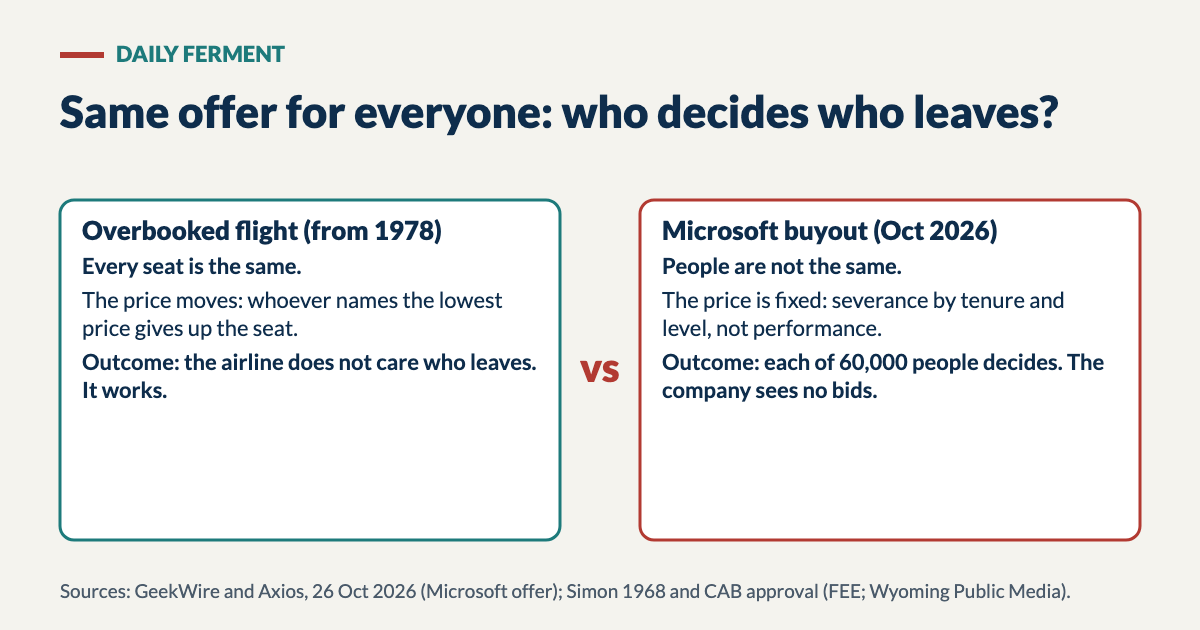
In 1968 the economist Julian Simon proposed that airlines stop bumping passengers at random and instead ask for volunteers, paying whoever names the lowest price to give up a seat, as FEE recounts. It took nearly twelve years before the Civil Aeronautics Board approved the idea, according to the University of Wyoming's American Heritage Center, and airlines adopted it in 1978. It works, and the reason is easy to miss. The airline does not care who gives up seat 23C. Every passenger who leaves frees the same seat. So the auction can let the passenger with the cheapest alternative leave, and everyone is better off.
A buyout borrows the volunteer part and drops the rest. Employees are not interchangeable seats, so the company does care who goes. And the price is not an auction at all: it is one formula for everyone, which here means more money for longer tenure and higher level, regardless of how good someone is or how many offers they hold.
Overbooked flight, volunteer auction (from 1978)
- What leaves a seat, and every seat is the same
- The price moves until someone accepts
- Who goes whoever values the seat least
- Does the airline care who? No
Microsoft voluntary exit (Oct 2026)
- What leaves a person, and people differ
- The price fixed: severance by tenure and level
- Who goes whoever the formula suits, by their own options
- Does Microsoft care who? Yes, but performance is not a factor
Sources: FEE (13 Jul 2022) and Wyoming Public Media (13 Feb 2024) on Julian Simon's proposal and its approval; GeekWire and Axios, 26 Oct 2026.
So what does Microsoft's design select for?
Here is where I move from what is reported to what I infer. With no performance test and no age floor, the formula pays most to people with long tenure and senior levels. The cheque is smallest for a strong engineer with three years in, which may help keep exactly those people. But that same engineer, if a rival is already offering more, needs very little extra to leave, and the offer gives a clean exit with stock still vesting.
Microsoft has two filters I can see. One is team level: leaders chose whether their groups take part, and sales chose not to. The other I cannot see, and no report I read says it exists: whether a manager can refuse an individual who says yes. That single detail decides whether this is Tsuru's firm, which could not control who left, or something closer to an offer the company can still steer.
There is one more effect. Coleman told GeekWire in July that Microsoft was looking at voluntary exits as a regular, possibly annual, tool. A buyout that comes every year teaches people to wait for the next one, the same way deadlines that move every year teach people to wait. Someone thinking of leaving in spring now has a reason to hold until the next offer.
None of this says the buyout is a mistake. A flat, public formula is fair in a way a case-by-case deal is not, and it spares people the worse version, layoffs chosen for them, which Microsoft also used in July. Axios, citing CNBC, links the pressure to Microsoft's data centre spending for AI; whether AI is changing how many people a firm needs is still an open question outside tech. It just means the outcome is decided by 60,000 private calculations, and the company has agreed not to see the bids.
How sure am I?
- Established
- The offer's size, eligibility, deadline and package as reported by GeekWire and Axios; the spring program's 8,750 eligible and 30% take-up; the two studies' findings; Simon's proposal and its adoption.
- Inferred
- That a price set by tenure and level, with only a team-level filter, leaves the selection to each person's outside options.
- Guess
- That the people who accept will skew toward those who already have an offer elsewhere. Microsoft's earnings on Wednesday, 28 October, may show the expected cost, which would let anyone work backwards to the expected take-up.
A buyout at one price is an auction where the company has agreed not to look at the bids, and that only works when it doesn't matter who leaves.
More on Daily Ferment: The UK will curb non-competes. Football shows where the restraint goes next. and MongoDB's CEO left for Meta. Why didn't the reassurance work?
Sources
- GeekWire, Todd Bishop: Microsoft makes new 'voluntary exit' offer to about a quarter of its workforce, 26 Oct 2026
- Axios Seattle, Melissa Santos: Microsoft offers buyouts to roughly a quarter of its workforce, 26 Oct 2026
- Tsuru, T. (2005), 'Buyout' and Adverse Selection in Employment Adjustment, Keizai Kenkyu 56(1)
- Whelan, Ehrenberg, Hallock and Seeber (2011), Adverse Selection and Incentives in an Early Retirement Program, NBER Working Paper 17538
- FEE, Peter Jacobsen: Delta paid passengers $10,000 to give up their seats, 13 Jul 2022
- Wyoming Public Media, Archives on the Air: How much is that seat worth?, 13 Feb 2024