Stack Overflow got 969 questions in September. Who writes the next answers?
Stack Overflow questions per month are under 1,000. The questions didn't stop. They moved into private AI chats that leave no public record.
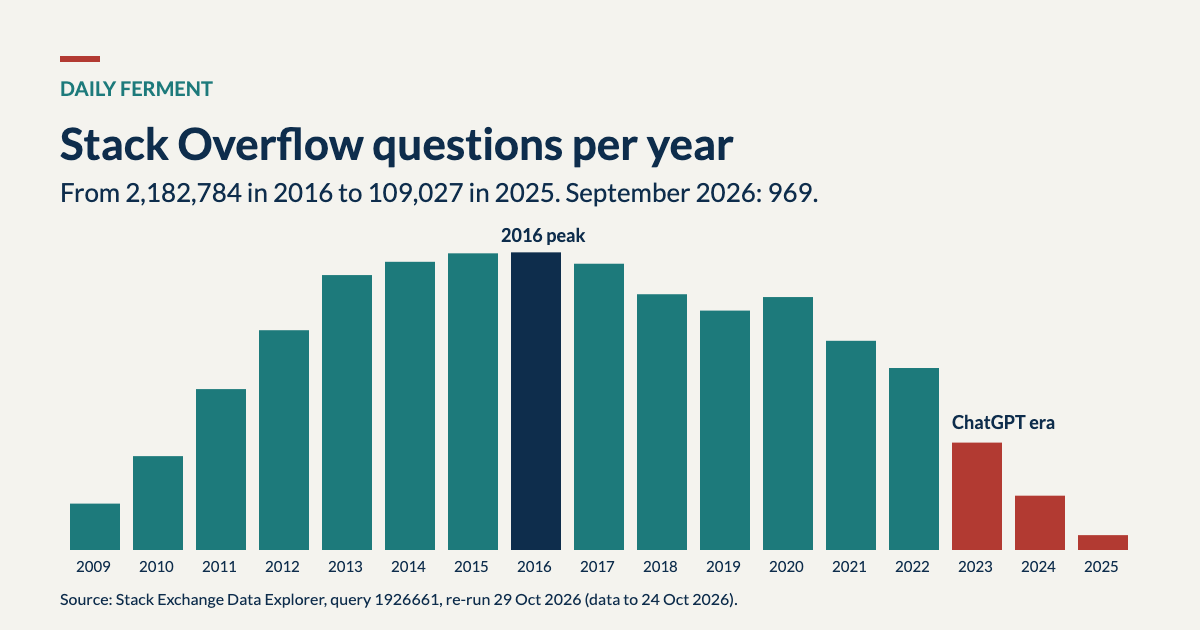
Stack Overflow received 969 new questions in September 2026, according to a public query of its own data that reached the top of Hacker News on 28 October. In March 2014 it got 207,169. So yes, Stack Overflow questions per month are now under 1,000, and the slide started long before AI chat arrived. The part I care about is what happens next: the questions didn't stop, they moved into private chats, and a private chat leaves no record for anyone else to learn from.
How far have Stack Overflow questions fallen?
The query runs in Stack Exchange Data Explorer, and I re-ran it on 29 October to check. It counts every question on Stack Overflow by the month it was posted. The peak month was March 2014. The busiest year was 2016, with 2,182,784 questions.
Guess first: how many new questions did Stack Overflow get in the whole of 2025?
109,027. That is about what it used to get in one month: November 2022 alone had 109,120.
Source: Stack Exchange Data Explorer, query 1926661 (questions on Stack Overflow by month), re-run 29 Oct 2026.
My first reaction was that the headline might be a trick of a half-finished month. It partly is. Data Explorer refreshes once a week, and its help page says the last update was 24 October. So the October figure of 808 covers only 24 days; spread over a full month it would land just above 1,000. September is the clean number, and September was 969. The headline holds, but only just, and only because of September.
Did ChatGPT kill Stack Overflow?
Not on its own. OpenAI launched ChatGPT on 30 November 2022. That month Stack Overflow got 109,120 questions, already about half of the 2014 peak. The decline was a slow slope for eight years and then a cliff.
- March 2014 Peak month: 207,169 questions.
- 2016 Busiest year: 2,182,784 questions.
- November 2022 ChatGPT launches; Stack Overflow gets 109,120 questions that month.
- 2023 to 2025 Yearly totals fall to 787,572, then 398,345, then 109,027.
- September 2026 969 questions, the first full month under 1,000.
Sources: Stack Exchange Data Explorer, query 1926661; OpenAI, 30 Nov 2022.
The slow part has other causes: a site that had already answered the common questions, a famously strict welcome for newcomers, and search engines that served old answers well. The cliff lines up with AI chat. I can't prove that from a count, but the timing is hard to wave away.
Where else has a public record gone quiet?
The comparison that helped me is local newspapers. In 2020 three finance researchers, Pengjie Gao, Chang Lee and Dermot Murphy, published a study in the Journal of Financial Economics on what happens to a place's public finances after its local paper closes. Their answer: after a paper closed, the local government paid 5 to 11 basis points more to borrow. Government wages and deficits went up too.

The mechanism is the part that transfers. Nobody at the bond desk read the local paper for fun. The paper was a public record that other people quietly relied on, and when it closed, the cost didn't show up at the newspaper. It showed up somewhere else, years later, in a number that had nothing to do with journalism.
The Brookings summary of the work puts it plainly: there is "not a sufficient degree of substitutability" between local papers and other sources of information. In the US, Northwestern's Medill school counted 213 counties with no local news source in 2025.
It's the same question publishers are now asking about AI answers, which I looked at in Google will pay for AI answers. It won't show the meter.
Stack Overflow was that kind of record for software. A developer asked in public, someone answered in public, a third person corrected it, and the whole exchange stayed up for the next person, for search engines and for the AI models trained on the web. A question asked to a chatbot today gets an answer only the asker sees. If it's wrong, nobody corrects it in public. If it's right, nobody else gets to reuse it.
Local newspaper
- What it was: a public record of local government
- Who relied on it: voters, and quietly, bond buyers
- Where the cost showed up: municipal borrowing costs up 5 to 11 basis points
- When: years after the closure
Stack Overflow
- What it was: a public record of programming problems and fixes
- Who relied on it: developers, search engines, AI models
- Where the cost may show up: weaker answers on newer tools (my guess)
- When: not yet measured
Sources: Gao, Lee and Murphy, Journal of Financial Economics, 2020; Stack Exchange Data Explorer, query 1926661.
What does it mean for developers using AI to code?
Here is my guess, and I'm marking it as a guess. The models answer well on tools that were around while Stack Overflow was busy, because there is a deep public record to learn from. For libraries and frameworks released after 2024, that record is thin, because the questions about them went into private chats. If that's right, the cost of an empty Stack Overflow won't show up on Stack Overflow's chart. It will show up as weaker answers on new tools, the way the newspaper closures showed up in bond yields. Companies pushing teams to write everything with AI, as in Epic banned hand-written code, are leaning on that record harder than ever.
What would change my mind: a study showing AI coding answers are just as good on newer libraries as on older ones, or evidence that the questions moved to another public place, like project forums or GitHub discussions, rather than into private chats.
How sure am I?
- Established
- Stack Overflow got 969 questions in September 2026 and 207,169 in March 2014, from its own public data, re-run on 29 October. October is still partial.
- Inferred
- The cliff after 2022 is mostly AI chat. The timing fits; a count can't prove cause.
- Still a guess
- That AI coding answers will get weaker on newer tools because the public record stopped growing. Nobody has measured it that I've found.
When answers move from a public site into private chats, the cost doesn't show up where the questions used to be; it shows up later, in whatever learned from the public record.
More on Daily Ferment: arXiv now limits you to two papers a month. It's rationing the reader. and AI hasn't paid off outside tech. Electricity took four decades.
Sources
- Stack Exchange Data Explorer: questions per month on Stack Overflow, query 1926661, re-run 29 Oct 2026
- Stack Exchange Data Explorer: help page, weekly refresh, last update 24 Oct 2026
- OpenAI: Introducing ChatGPT, 30 Nov 2022
- Gao, Lee and Murphy: Financing dies in darkness? The impact of newspaper closures on public finance, Journal of Financial Economics, 2020
- Brookings: Financing dies in darkness? The impact of newspaper closures, 24 Sep 2018
- Medill, Northwestern University: News deserts hit new high, 20 Oct 2025