Cambridge made "human" its word of the year. The word "organic" shows what happens to a label like that.
Cambridge picked "human" because we now write human-written and human-made. The word organic took that road before: a label, a rule, certifiers, then a fraud.

On 17 November 2026 Cambridge Dictionary named "human" its Word of the Year for 2026. Why pick a word that has been in English for centuries? Because it has started doing a new job. Cambridge says it is "increasingly seen in compounds such as human-written, human-generated, and human-made," and now also means something "created by or typical of people as opposed to AI." In plain terms, "human" has become a label for the old default. Labels like that have a history, and the last big one, "organic", went from an ordinary word to a federal standard to a $142 million fraud.
Why did Cambridge pick "human" for 2026?
Cambridge's announcement ties the choice to the year's arguments about AI: the Authors Guild's "Human Authored" mark for books, performers registering trademarks on their voices and faces, writers objecting to their work being used to train language models. Colin McIntosh, a Cambridge Dictionary lexicographer, put it simply: "AI is changing how we talk about being human."
My first reaction was that this is what a word of the year mostly is: a dictionary's yearly marketing moment, wrapped around a mood. Some of it is. But one part of Cambridge's explanation holds up without the mood, and it's the narrow, linguistic part. People used to write "a novel". Now some of them write "a human-written novel". The word hasn't changed. What changed is that it's needed.
What is a retronym, and is "human" one?
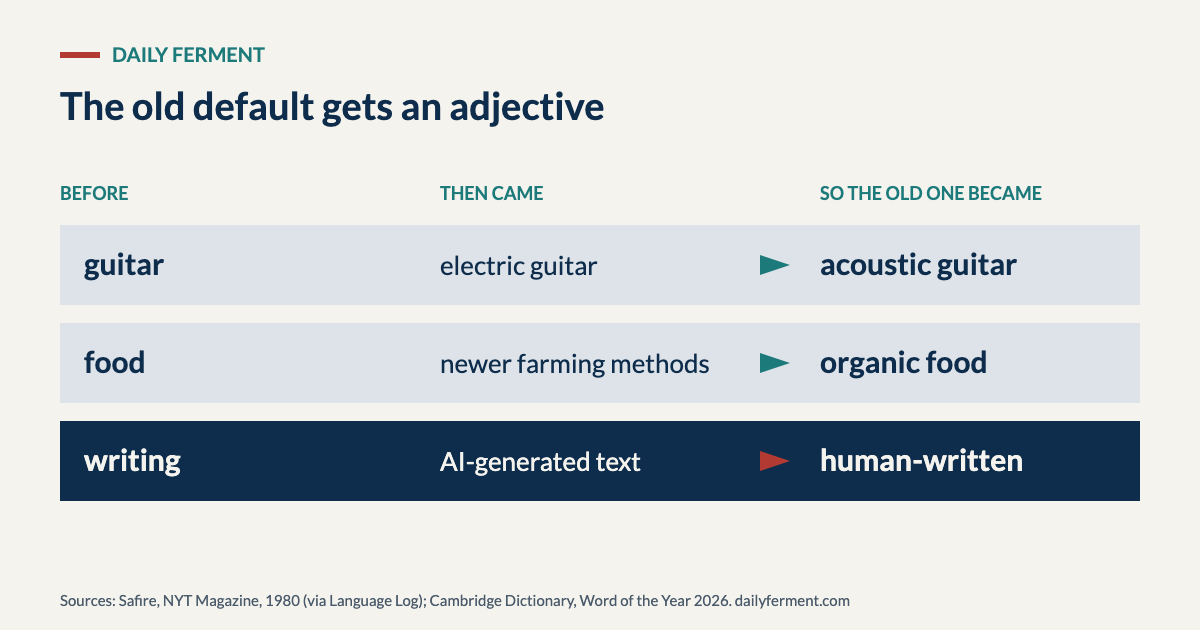
Linguists have a word for this. In July 1980 William Safire's "On Language" column in the New York Times Magazine credited Frank Mankiewicz, then president of NPR, with "retronym": a noun that picks up an adjective to tell it apart from something newer. A guitar was a guitar until the electric guitar arrived; then the old one became an "acoustic guitar". Merriam-Webster's examples add film camera, snail mail, desktop computer and brick-and-mortar store, and note that "many retronyms arise from technological change."
"Human-written" is a retronym in the making. Writing didn't need the adjective until machines could produce text that passes for it. The adjective turns up when the default stops being safe to assume.
- 27 July 1980 William Safire prints "retronym", credited to Frank Mankiewicz
- 21 December 2000 USDA publishes its National Organic Program rule
- 2002 The organic rule is fully in force, 18 months after taking effect in February 2001
- 2010 to 2017 Randy Constant sells over 11.5 million bushels, over 90% falsely marketed as organic
- August 2019 Constant is sentenced to 122 months
- January 2025 The Authors Guild launches its Human Authored mark
- 17 November 2026 Cambridge Dictionary names "human" its Word of the Year
Sources: Language Log; Federal Register; US Attorney, Northern District of Iowa; Authors Guild; University of Cambridge.
What happened to "organic" when it became a label?
Cambridge makes the comparison itself, quoting the Economic Times: "Human-made is the new organic." I think the comparison is better than Cambridge lets on, so I followed it.
"Organic" names an old way of farming once a newer way became the norm, the same move as "acoustic". That's my reading, not Cambridge's. Once the word carried a price premium, it needed rules. The US Department of Agriculture published its National Organic Program rule on 21 December 2000. It took effect in February 2001 and was fully in force 18 months later. Anyone selling or labelling food as organic had to be certified by an accredited certifier, with an exemption for very small sellers.
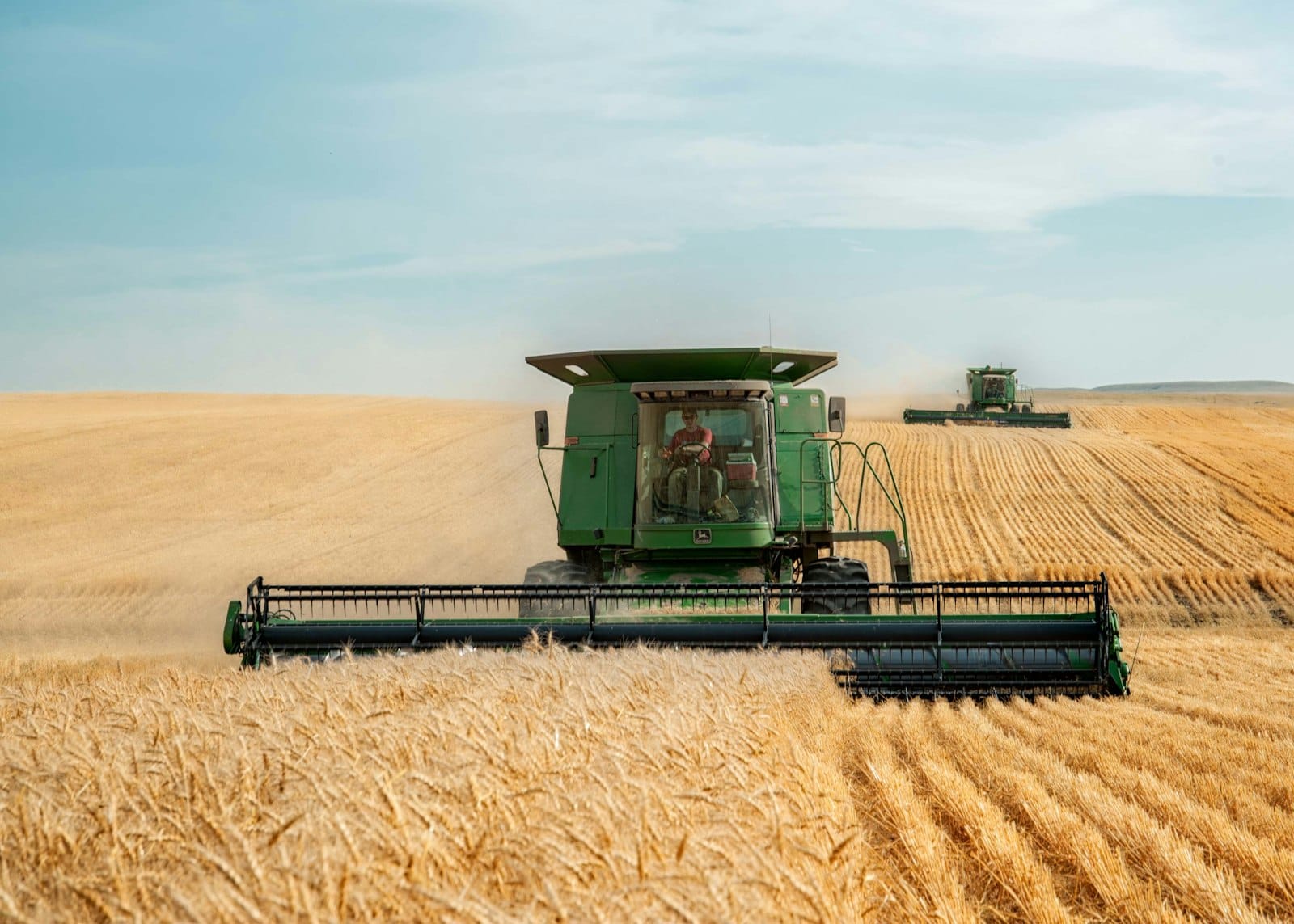
Then the label got tested. Between 2010 and 2017 Randy Constant, a grain seller from Missouri, sold more than 11.5 million bushels of grain, over 90% of it falsely marketed as organic, according to the US Attorney's Office in northern Iowa. He admitted at least $142 million in sales. In 2016 his sales were equal to about 7% of US organic corn and about 8% of organic soybeans. Much of it went into feed for animals later sold as organic. He told buyers the grain came from his certified organic fields. It didn't: some was bought from other farmers, some grown with chemicals the rules forbid, some mixed with ordinary grain. In August 2019 he was sentenced to 122 months in prison.
What strikes me is the mechanism. The certification was real. It covered fields and paperwork. Nobody was checking the grain by looking at it, and the paper trail pointed at certified land. For seven years the label held because the paperwork held.
Will "human-made" go the same way?
"Organic"
- Old default Farming without the newer methods
- The label USDA rule, 2000; certified by accredited agents
- What gets checked Fields and paperwork, not each bushel
- Known failure Constant, 2010 to 2017, at least $142 million in sales
"Human-made"
- Old default Writing, art and music made by people
- The label Authors Guild Human Authored mark, 2025, and others
- What gets checked Registration and a signed licence; no check on the text described
- Known failure None I could find yet
Sources: Federal Register, 21 December 2000; US Attorney, Northern District of Iowa, 19 August 2019; Authors Guild, 29 January 2025. The "old default" rows are my reading.
The early signs fit the pattern. The Authors Guild launched its Human Authored mark in January 2025. An author registers a book, signs a licence and gets a numbered mark, backed by a public database the Guild calls "a verifiable chain of trust between author and reader." Light AI use for spelling or brainstorming is allowed. The announcement doesn't describe any check on the text itself, and I'm not sure what such a check would look like. As with the grain, what's being certified is the process, and the process doesn't show in the product.
So my guess at the order of events runs like organic's. A premium word first: Cambridge says businesses have started to highlight "human made" and calls the idea a "human premium". Then competing marks. Then a standard someone enforces. Then the first case where the paperwork said human and the work wasn't. If human-made is the new organic, the useful question isn't whether the label means something. It's who checks, and what they actually look at.
I've written about the moment a default flips before, with petrol cars and cash: once the old way becomes the minority, someone has to decide who pays to keep it running. And about Black Friday prices, where a label on a price only means what the rule behind it makes it mean.
How sure am I?
- Established
- Cambridge's pick, definition and its own account of the human-written, human-generated and human-made compounds and the "new organic" line; Safire's 1980 column and Mankiewicz; the USDA rule dates; the Justice Department figures in the Constant case; what the Authors Guild page says about its mark.
- Inferred
- That "human" is working as a retronym, and that organic's weak point, certifying the process rather than the product, carries over to human-made claims. Cambridge didn't publish lookup or usage numbers, so I can't say how fast the compounds are spreading.
- Still a guess
- That human-made labels will get an enforced standard and then a fraud case. I don't know of one yet.
When an old default starts needing a label, the label is only as good as the check behind it, and "human-made" will be checked the way "organic" was: through paperwork about the process, not by looking at the product.
More on Daily Ferment: When petrol cars become the minority, who pays? and A third of Amazon's Black Friday deals saved nothing. A dice experiment in sentencing shows why the struck-through price still works.
Sources
- University of Cambridge, Cambridge Dictionary reveals Word of the Year 2026, 17 November 2026.
- Cambridge Dictionary, Word of the Year 2026: Human, 18 November 2026, and its interactive explainer.
- Ben Zimmer, RIP Frank Mankiewicz, coiner of "retronym", Language Log, 24 October 2014 (on Safire's column of 27 July 1980).
- Merriam-Webster, Word of the Day: retronym, 12 March 2020.
- USDA Agricultural Marketing Service, National Organic Program final rule, Federal Register, 21 December 2000.
- US Attorney's Office, Northern District of Iowa, press release on the sentencing of Randy Constant and three Nebraska farmers, 19 August 2019.
- Authors Guild, AG launches Human Authored certification, 29 January 2025.