Energy drink reports mention cardiac arrest 11 times as often. A pilots' incident log shows why that isn't the risk.
Reports about energy drinks mention cardiac arrest 11 times as often. That's a share of complaint reports, not of drinkers, and aviation's safety log shows why it matters.
On 2 November 2026 the American Heart Association put out a number that travelled fast: reports about energy drinks and stimulant supplements mentioned cardiac arrest about 11 times as often as reports about other foods and supplements. The research, by Sai Samayamanthula, a medical student at the University of Virginia School of Medicine, was presented at the AHA's Scientific Sessions in Chicago and was picked up on Hacker News this week. So can energy drinks cause cardiac arrest? This study can't tell you, and it doesn't claim to. It counted which problems turn up in a pile of voluntary reports to the US Food and Drug Administration. That's a signal worth chasing. It isn't 11 times the risk.
The clearest way I found to see the difference comes from a database built for pilots.
What did the energy drink study actually measure?
Source: American Heart Association, 2 November 2026, abstract P8783; ScienceDaily.
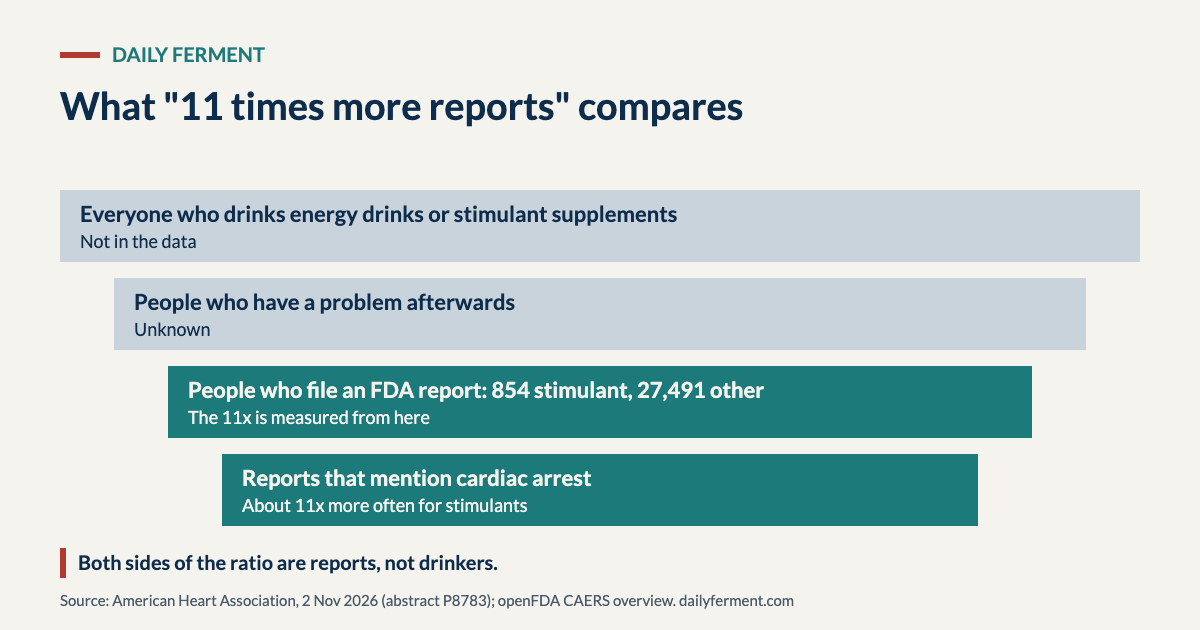
The data came from an FDA safety database of adverse event reports about foods and supplements, filed from 2017 to 2025 for people aged 13 and over. Of 28,345 reports, 854 involved products with caffeine or other stimulants: guarana, yerba mate, green tea and coffee extracts, synephrine, yohimbine, DMAA and others. Products were grouped by ingredient, not brand. The other 27,491 reports were about things like soft drinks, smoothies, vitamins, protein bars and meal replacement shakes.
Compared with that second group, the stimulant reports mentioned cardiac arrest about 11 times as often, heart attack about 4.5 times, arrhythmias or palpitations about 4 times, and chest pain 2.71 times. About 45% of the heart-related reports involved adults aged 18 to 34. The AHA calls the work preliminary; it hasn't been peer reviewed.
Does 11 times more reports mean 11 times the risk?
My first reaction to the headline was alarm. My second was a question: 11 times of what? I looked for the number of cardiac arrest reports in each group and couldn't find it in the AHA release or the ScienceDaily write-up. The abstract itself sits behind the meeting's planner. So I don't know if "11 times" is built on dozens of reports or a handful.
What I can say is what kind of number it is. Both sides of the comparison are reports. It's the share of stimulant reports that mention cardiac arrest, set against the share of other reports that do. Nobody in the data is a person who drank an energy drink and felt fine, because those people don't file reports. The release says this itself: the number of people who used these products without a problem is unknown, and so is the number who had a heart event and never reported it.
The FDA's own page on these reports is blunter than any headline. A causal relationship "cannot be established between product and reactions listed in a report," and the reports "cannot be used to estimate the incidence of these events."
Why does a pilots' incident log matter here?

Aviation has run the same kind of system for decades. NASA's Aviation Safety Reporting System collects voluntary reports from pilots, air traffic controllers and others; more than a million have come in, and the searchable database goes back to 1988. NASA's description of its data could be pasted onto the FDA's. Reports are "subject to self-reporting biases", ASRS doesn't verify them, and so the number of reports on a topic "cannot, therefore, be used to infer the prevalence of that problem".
ASRS also shows the other half: who reports depends on why they report. The FAA gives limited immunity from enforcement to people who file within 10 days of an incident, as a deliberate incentive. That's good safety policy, and it means the pile leans toward the incidents where someone wanted that protection. Nobody in aviation reads a jump in reports about one kind of event as a jump in the event. They read it as a place to look.
FDA food and supplement reports
- Who files Consumers and health workers, voluntarily; supplement makers must forward serious reports
- What is counted Reports, not people who used the product
- FDA says Cannot be used to estimate how often events happen
- Good for Spotting where to look
NASA aviation safety reports
- Who files Pilots, controllers and others, voluntarily; limited immunity if filed within 10 days
- What is counted Reports, one person's view of an event
- NASA says Cannot be used to infer how common a problem is
- Good for Spotting where to look
Sources: openFDA, CAERS overview; CRS RS22480; NASA ASRS, About ASRS Data; FAA ASIAS.
So what else could push the ratio up?
Three things besides danger can move a ratio like this. I can't tell from the release how much each one contributed.
The first is what else is in the comparison pile. If most reports about protein bars and smoothies are about stomach trouble or allergic reactions, cardiac arrest will be a tiny share of them, and any product whose reports run more serious will look many times worse by contrast.
The second is who has to report. Under a 2006 US law, the company named on a dietary supplement's label must pass any report of a serious adverse event it receives to the FDA within 15 days. The Congressional Research Service summary of that law covers supplements and over-the-counter drugs, not ordinary foods. Some products in the stimulant group are supplements, like pre-workout powders; soft drinks in the comparison group aren't.
The 2006 law that makes supplement makers report
The Dietary Supplement and Nonprescription Drug Consumer Protection Act (Public Law 109-462) was enacted on 22 December 2006. The company named on the label of a dietary supplement or over-the-counter drug must send the FDA any report it receives of a serious adverse event, within 15 days, according to the Congressional Research Service summary. The summary does not cover ordinary foods such as soft drinks. The AHA release doesn't say how many of the 854 stimulant reports were about supplements, so I can't say how much this tilts the comparison.
Source: Donna V. Porter, Congressional Research Service, RS22480, updated 23 January 2007.
The third is attention. When doctors and families already suspect energy drinks, a heart event after one is more likely to be tied to the can and written up. That one is my inference; the study didn't test it.
None of this makes the signal false. The ratio could be mostly real danger. A cluster like this is exactly what these databases exist to surface. It's the jump from "surfaced" to "11 times the risk" that the data can't make.
What should someone who drinks them take from it?
The useful numbers in the release aren't the ratios, they're the doses. The AHA's 2026 scientific statement puts up to 400 mg of caffeine a day as generally safe for most adults. Some energy drinks carry up to three times the caffeine per fluid ounce of brewed coffee, and some pre-workout supplements more than 12 times. Samayamanthula himself says that "for many healthy people, if these products are consumed occasionally, the risk is probably small." Reading a label against 400 mg is something you can do today. The 11 times isn't.
I've run into this trap twice before. With donated NFL brains, the people who chose to donate weren't a sample of players. With a smartwatch that flags high blood pressure, what mattered was who gets flagged and what happens next. A report database is the first kind of sample: it's made of the people who decided to speak up.
How sure am I?
- Established
- The study's counts, ratios, ages and stated limits as published by the AHA on 2 November 2026; the FDA's and NASA's descriptions of their report databases; the FAA's 10-day immunity rule; the 2006 supplement reporting law as summarised by the Congressional Research Service.
- Inferred
- That the 11 is a ratio of report shares, and that the make-up of the comparison pile and mandatory reporting for supplements can push it up. I haven't seen the abstract's method or the raw counts.
- Still a guess
- How much of the 11 is real extra danger. It could be most of it. Only a study that counts people, not reports, can tell.
A pile of voluntary reports tells you where to look, not how often something happens; the energy drink study is a reason to run a proper risk study, not evidence of 11 times the risk.
More on Daily Ferment: Nearly every donated NFL brain had CTE. The answer was in the ones nobody donated. and A smartwatch caught two in three hidden cases of high blood pressure. Smoke alarms show what decides if that helps.
Sources
- American Heart Association newsroom, Energy drinks, stimulant products linked to cardiac arrest, heart attack in young adults, 2 November 2026 (Scientific Sessions 2026, abstract P8783).
- ScienceDaily, Energy drinks linked to 11 times more reports of cardiac arrest, 11 November 2026 (source: American Heart Association).
- openFDA, Adverse Food Event overview (CAERS), read 19 November 2026.
- Donna V. Porter, Congressional Research Service, Dietary Supplement and Nonprescription Drug Consumer Protection Act (P.L. 109-462), RS22480, updated 23 January 2007.
- NASA Aviation Safety Reporting System, About ASRS Data, read 19 November 2026.
- FAA Aviation Safety Information Analysis and Sharing, ASRS information, read 19 November 2026.