Data centers drove the new power lines. Households got about half the bill. Heavy trucks did the same to roads first.
A Nature Energy study finds US homes are allocated a median 47% of the grid costs tied to data center growth. Heavy trucks and road taxes show how that happens.
In regulated electricity tariffs across the US, residential customers are allocated a median of 47% of the grid costs tied to data center growth, "despite contributing far less to demand growth." That's from a paper by Cheng Feng and Fengqi You of Cornell University, published in Nature Energy on 9 November 2026.
So, do data centers raise electric bills? In the places most exposed to them, yes. The same paper finds that wholesale price increases attributable to data centers passed 10% in the most exposed price hubs by 2025. And the way grid costs are shared out pushes part of the rest onto homes that never see a data center. The pattern isn't new. Roads went through it with heavy trucks, and the fix there is still unfinished.
Source: Cheng Feng and Fengqi You, Nature Energy, 9 Nov 2026, abstract.
Who pays for data center electricity?
Feng and You combined price records with transmission plans and the regulatory dockets where utilities and commissions decide who pays for what. The abstract reads like a list of channels. Wholesale prices: up more than 10% in the most exposed hubs. Regulated tariffs: residential customers allocated a median of 47% of costs. Geography: "rural communities ... bear burden increases 76% larger than urban communities." Income: "the lowest-income households face extra energy burdens up to 28 percentage points." And the jobs and tax revenue that are meant to make up for it barely track what states spend to attract data centers, with a spending elasticity of 0.16.
I've only read the abstract and the data statement; the full text is behind a paywall. Cornell's own summary adds detail I'm treating as secondary: about $8.25 billion of new infrastructure tied to data centers in 2025, of which data centers paid about 38%; transmission investment across the four grids studied rising from $2 billion in 2020 to $34 billion in 2025; wholesale prices up about 15% in Virginia and 20% in the southern San Francisco Bay Area.
Fengqi You put the question in one line in that summary: "With the booming of data centers, who pays for that expansion and who benefits?"
My first reaction: that's just demand and supply
When a big new buyer turns up in any market, prices go up for everyone. That's the wholesale channel, and it's hard to call it unfair. Data centers bid for the same power as everyone else, and a tight market costs everyone more. If that were the whole story, the answer would be to build more supply and wait.
Then I looked at the two numbers side by side. The wholesale effect is a market doing what markets do. The 47% isn't a market at all. It's an allocation, decided in rate cases, of costs for wires and substations that were built because a few very large customers asked for them. That's a choice about how to divide a bill, and it can be made differently.
"You do not have to live next to a data center to help pay for its power infrastructure,"
Fengqi You, Cornell University, in the Cornell Chronicle, 9 November 2026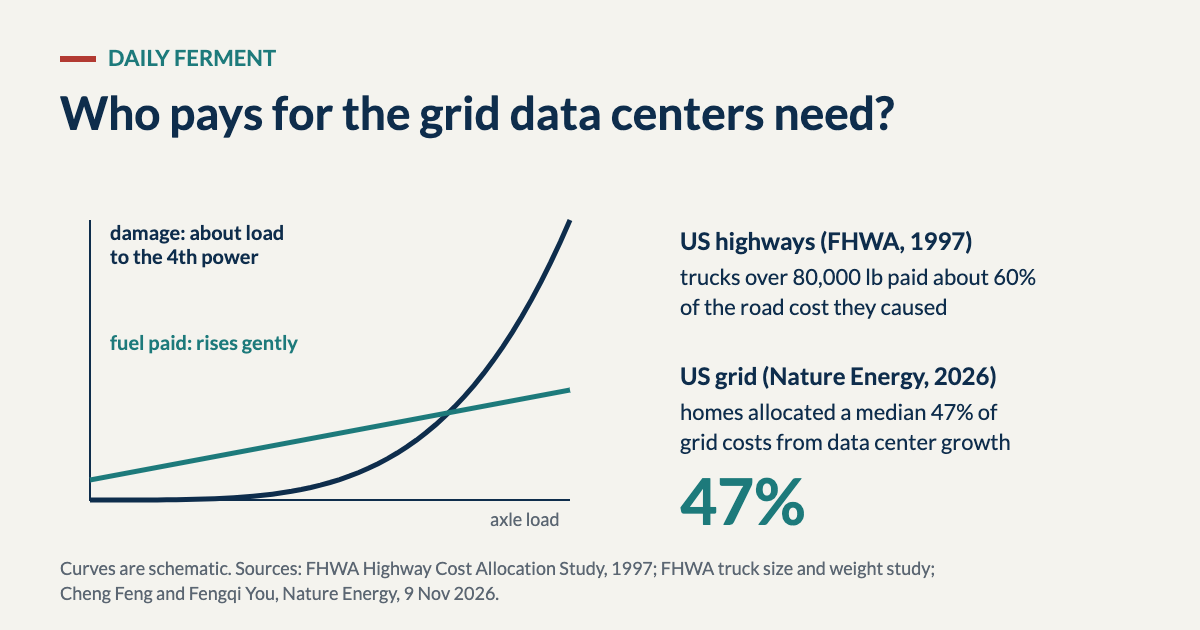
The cross: how trucks paid for roads
Road engineers ran into this decades ago. In the late 1950s the AASHO Road Test in Ottawa, Illinois, measured how test pavements wore down under loaded traffic. The rule of thumb that came out of it, as the Federal Highway Administration describes it, is that pavement damage rises with roughly the fourth power of axle load.
Guess first: under the road engineers' rule of thumb, if an axle load doubles from 10,000 to 20,000 pounds, how many times more pavement damage does it do?
About 16 times. That is the fourth power rule from the AASHO Road Test. Later work put most kinds of wear closer to the third power, about 8 times. Source: FHWA, Comprehensive Truck Size and Weight Study, Volume III, Chapter V.

Later work softened it. The same FHWA chapter says that for most kinds of wear the relationship "may be closer to a third power", so a doubled load does about eight times the damage, not sixteen. Either way, the cost of a road is driven hard by its heaviest users.
But much of what road users pay comes through fuel tax, and a truck's fuel bill doesn't climb anything like the fourth power of its axle weight. So the bill doesn't follow the damage, and FHWA's own numbers show it. FHWA's 1997 Highway Cost Allocation Study worked out what each kind of vehicle paid against what it was responsible for. Cars came out at 1.0, paying their share. Pickups and vans at 1.4, paying "substantially more than their share." Combination trucks registered over 80,000 pounds came out at about 0.6, the heaviest at 0.5.
US roads
- What drives the cost axle weight, roughly to the fourth power
- What users pay by mostly fuel bought
- Who comes out short trucks over 80,000 lb paid about 60% of their cost
- Who makes it up pickups and vans paid 1.4 times theirs
US grid
- What drives the cost the biggest new loads and their peaks
- What users pay by shares set for customer classes in rate cases
- Who comes out short data center growth, per the study
- Who makes it up residential users, allocated a median 47%
Sources: FHWA 1997 Highway Cost Allocation Study, Table 7; FHWA truck size and weight study, Vol. III, Ch. V; Feng and You, Nature Energy, 2026.
The grid version has the same shape. The cost of new transmission is driven by the biggest new loads and their peaks. Much of the bill is then shared across customer classes in rate cases, which is where the 47% comes from. When the measure you bill by grows more slowly than the thing that causes the cost, the smallest users pay for the biggest. I wrote about the road side of this before, when fuel tax starts to fail as petrol cars become the minority.
What a fix looks like
The grid is trying its version of a weight-based charge now. In July 2025 Ohio's Public Utilities Commission adopted AEP Ohio's proposal that new large data centers pay for "a minimum of 85% of the energy they are subscribed to use," even if they use less, for 12 years including a four-year ramp-up, with an exit fee if a project is cancelled. That's billing by what a customer asked the grid to be ready for, not just by what flowed. It's the electrical version of charging a truck by its axle weight. The Nature Energy paper cites that Ohio docket, along with dockets in Virginia, Georgia and Pennsylvania and a federal proceeding.
Cornell's summary says the authors also suggest data centers cut use during about 22 peak hours a year. Peaks are what drive new lines, so that goes at the cause, not the average.
This matters outside the US too, though I haven't tested it. Anywhere a regulator spreads the cost of new grid across customer classes by energy used, a handful of very large new loads can shift cost onto households in the same way. It's also part of why votes against data centers keep winning, as I found when voters went against them in 40 of 41 ballot measures.
When a cost grows with the size of the biggest user but the bill is shared by a flat measure, the small users end up paying for the big one, on roads and now on the grid.
- Established
- The paper's abstract figures; FHWA's cost ratios; the fourth power rule and its later softening; the terms of Ohio's data center tariff.
- Inferred
- That the grid and the road share one mechanism, and that it travels to other countries that share grid costs by class or by energy. I have read the abstract, not the full methods.
- Guess
- That charging data centers for the capacity and peaks they ask for would pull the residential share well below half. Ohio is too recent to show it.
What I'd watch next is whether the 47% moves in the dockets decided after Ohio's. That's a number regulators set, which means it can be changed.
More on Daily Ferment: Anthropic has committed $895 billion to compute. California's 2001 power deals show the catch. and AI hasn't paid off outside tech. Electricity took four decades.
Sources
- Cheng Feng and Fengqi You, Data centres asymmetrically exacerbate energy burdens through wholesale price increases and regressive grid cost shifting, Nature Energy, 9 November 2026 (abstract read; replication package on Zenodo).
- Caitlin Hayes, Data centers need power: lower income, rural residents pay the price, Cornell Chronicle, 9 November 2026.
- Federal Highway Administration, 1997 Federal Highway Cost Allocation Study, Summary Report, Chapter 3, Table 7.
- Federal Highway Administration, Comprehensive Truck Size and Weight Study, Volume III, Chapter V: Pavement.
- AEP Ohio, AEP Ohio Proposal on Data Centers to Protect Ohio Consumers Adopted by PUCO, 9 July 2025.