Brave now lets AI agents pay half a cent per search, no account needed. A 1999 paper says what that doesn't fix.
Brave Search API now takes x402 payments: $0.005 a query in USDC, no account. Nick Szabo's 1999 paper on micropayments shows what an agent fixes and what it only moves.

On Thursday, 12 November, Brave started answering some search requests with an error: 402 Payment Required. That is the point. The Brave Search API now accepts payment through x402, an open protocol Coinbase introduced in May 2025. So what is x402? It's a way to pay for a web request inside the request itself. An AI agent asks for results, Brave replies 402 with a price, the agent signs a payment in USDC, a dollar stablecoin, on Coinbase's Base network, sends the request again and gets its results back with a receipt. Brave charges $0.005 a query. No account, no API key, no card on file.
The price isn't the news. Brave's normal Search plan already costs $5 per 1,000 requests, the same half a cent. What changes is who is allowed in. On the normal plan you sign up, buy prepaid credits and give a card. Through x402, Brave's agent payments guide says, payment is the only credential, and each request carries its own payment. Brave is also paying the network fees on Base "for a limited time".
Sources: Brave blog, 12 Nov 2026; Brave Search API plans and agent payments guide, read 14 Nov 2026; RFC 2068, January 1997.
Why does a 1997 error code matter?
Guess first: how long has the web's "402 Payment Required" code been officially unused?
Since January 1997. RFC 2068 defined it as "reserved for future use", and RFC 9110 in June 2022 still says the same. Sources: RFC 2068 section 10.4.3; RFC 9110 section 15.5.3.
The 402 code has been in HTTP since RFC 2068, published in January 1997, where its whole definition is one line: "This code is reserved for future use." The current standard, RFC 9110 from June 2022, still says it is reserved for future use. For a quarter of a century the web kept a slot for paying per request and nobody filled it. Coinbase's launch post called 402 "a dormant feature of the web".
That gap is what made me stop. Micropayments are one of the oldest failed ideas online. DEC's Systems Research Center built Millicent in the 1990s, a protocol where you bought scrip from a broker and spent it in tiny amounts. Clay Shirky's 2000 essay "The Case Against Micropayments" is usually summed up the way David Rosenthal sums it up: users hate them, and users are the ones with the money.
- Jan 1997 RFC 2068 reserves HTTP 402 Payment Required "for future use".
- May 1999 Nick Szabo, "Micropayments and Mental Transaction Costs".
- Dec 2000 Clay Shirky, "The Case Against Micropayments".
- Jun 2022 RFC 9110: 402 is still reserved for future use.
- 6 May 2025 Coinbase introduces x402, built on the 402 code.
- 12 Nov 2026 Brave Search API accepts x402 payments, $0.005 a query, no account.
Sources: RFC 2068; Szabo (1999); Rosenthal (2021) on Shirky; RFC 9110; Coinbase (2025); Brave (2026).
My first reaction: agents fix the old problem
The best explanation I know of why micropayments failed is Nick Szabo's 1999 paper "Micropayments and Mental Transaction Costs". His point was that the computing cost of a tiny payment was never the real barrier. The barrier was the person paying. Every small charge is a small decision, a small doubt about the month's total, a small check on whether the thing was worth it. Szabo lists three sources of that cost: uncertain cashflows, the cost of observing what you're buying, and the cost of deciding.
So my first reaction was simple. An agent doesn't feel any of that. It won't hesitate over half a cent ten thousand times in a row. If people were the problem, take the person out of the loop and the old idea finally works. Coinbase's own "why now" list has cheaper fees on Base, stablecoins and AI agents. The last one looked to me like the change that matters.
Checking that against what Szabo actually wrote
Reading the rest of the paper, the reaction holds for one of his three costs, not all three.
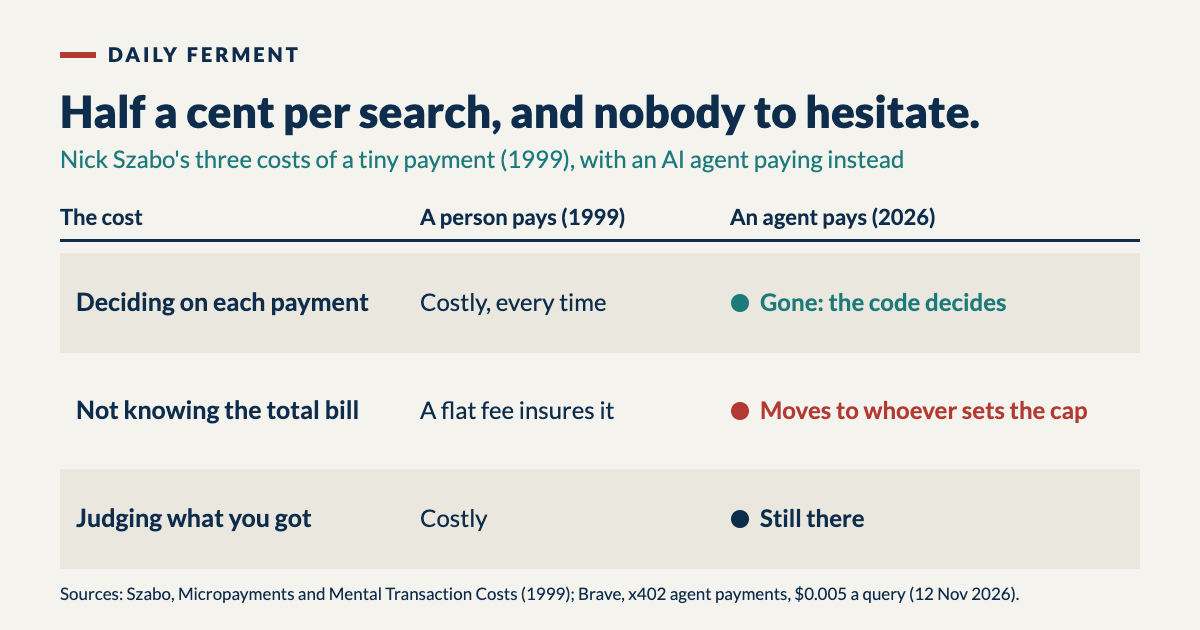
The decision cost does go. The agent absorbs it. That part is real.
The uncertain bill doesn't. This is the line from Szabo I keep coming back to:
"A flat fee constitutes an embedded, implicit insurance contract."
Nick Szabo, Micropayments and Mental Transaction Costs, May 1999
People paid monthly for phone and internet service not because they couldn't count, but because a flat fee caps the surprise. Szabo's examples are from the 1990s: AT&T advertising a flat per-minute rate against Sprint, and internet providers moving from hourly or usage charges to flat fees, with AOL the best-known case. Paying per query takes that insurance away. The surprise is still there. It just lands on whoever set the agent running.
The cost of judging what you bought doesn't go either. The agent still has to decide whether a result was worth half a cent, and someone still has to decide whether the agent decides well.
And Szabo had already thought about agents. In 1999 he wrote that "intelligent agents" were the proposed fix, and he doubted it. Because agents are programmed remotely, he wrote, it is hard for the consumer to tell "whether the agent is acting in the consumer's best interests, or in the best interests of the counterparty". He also said the interface for telling an agent your preferences was lacking. That reads differently in 2026, when the agent paying Brave can be written by someone other than the person whose wallet funds it. It's the same question I ran into with Meta's Muse agent and agency law: an agent that acts for you is still somebody's agent, and the hard part is knowing whose.
So where does the bill risk go?
Here is the cross, side by side.
Micropayments, 1990s
- Who decides each payment the person, every time
- What made it costly the decision and the doubt, not the computing (Szabo)
- What capped the bill flat monthly fees, the "implicit insurance"
- Who wrote the buyer nobody, the buyer was a person
x402 agent payments, 2026
- Who decides each payment the agent's code
- What it costs $0.005 a Brave query; network fees paid by Brave for now
- What caps the bill a per-request cap ($0.01 in Brave's example)
- Who wrote the buyer whoever built the agent, not always the person paying
Sources: Szabo (1999); Brave blog and agent payments guide (Nov 2026).
Under x402 the insurance a flat fee used to provide has to come from somewhere, and the only place it can live is the limit the agent runs with. Brave's guide shows one limit: a cap per request. Its example runs Purl, a command-line wallet developed by Stripe, with --max-amount 10000, which the page says is $0.01, twice the listed price. That stops a single query from being overcharged. It says nothing about how many queries. At $0.005 each, 10,000 searches cost $50 and a million cost $5,000 (my arithmetic, from Brave's listed price). The guide describes no daily or total budget and points to the wallet and an llms.txt file for the rest. I haven't checked whether other x402 wallets offer budgets, so I'm not claiming none do.
This is the same shape as a story from last month. When Xbox started selling cloud gaming by the hour, the fair question was who carries the bill once a flat plan grows a meter. And it's the mirror image of approval prompts. When every action needs a person's yes, people stop reading and approve, which is what Anthropic's own numbers on its permission prompts showed. x402 doesn't ask the person at all. That's a real fix for the decision cost and an open gap for the insurance.
The claim, in one sentence
An AI agent takes away the small decision that killed micropayments, not the uncertain bill; that risk moves to whoever sets the agent's spending limit, and a cap per request is not a budget.
How sure am I?
- Established
- Brave's x402 terms and $0.005 price, its normal $5 per 1,000 plan, the per-request cap in its guide; the RFC text on 402; what Szabo wrote in 1999.
- Inferred
- That the bill risk a flat fee used to absorb now sits with whoever sets the agent's limits, and that a per-request cap does not bound the total. I have not checked every x402 wallet for budget features.
- Guess
- That prepaid or flat "agent plans" come back, because the people funding agents will want the insurance Szabo described.
What would change my mind: x402 wallets shipping daily and monthly budgets as the default, or Brave and others selling prepaid "agent plans" that put the flat fee back. Szabo suggested bundling small purchases into bigger ones in 1999. If that happens, the half-cent query survives as an accounting unit and the person goes back to paying for certainty, just one level up.
More on Daily Ferment: AI agents could end the lazy-deposit discount. UK insurance shows who pays.; Stripe made OUSD the default. Who pays you to hold it?
Sources
- Brave, The Brave Search API now accepts agentic payments via the x402 protocol, 12 November 2026.
- Brave Search API, Agent payments guide, read 14 November 2026.
- Brave, Brave Search API plans and pricing, read 14 November 2026.
- Coinbase Developer Platform (Erik Reppel, Nemil Dalal, Dan Kim), Introducing x402: a new standard for internet-native payments, 6 May 2025.
- IETF, RFC 2068, Hypertext Transfer Protocol, HTTP/1.1, January 1997, section 10.4.3.
- IETF, RFC 9110, HTTP Semantics, June 2022, section 15.5.3.
- Nick Szabo, Micropayments and Mental Transaction Costs, May 1999.
- David Rosenthal, Millicent, 14 September 2021 (on Millicent and Clay Shirky's 2000 essay).