Nvidia is investigating whether its CEO was a spy target. Clearance rules say the hidden part was the risk.
The board isn't investigating an affair. It is asking whether a hidden relationship gave anyone leverage over Jensen Huang, and security clearance rules show why that is the question.
On Sunday 8 November 2026, the NVIDIA board said a committee of independent directors, with outside counsel, will investigate reporting that founder and CEO Jensen Huang "has been the target of a foreign intelligence effort." The same day Huang wrote to staff: "I was unfaithful to my wife." So why is Nvidia investigating Jensen Huang? Not for the affair as such. The board is checking whether a relationship he kept hidden was used to get at him, and whether anything leaked. It says it has "no reason to believe" anything did. That distinction is the whole story, and the US security clearance rules explain it better than any of the coverage I read.
What the board actually said
- Earlier in 2026 A memo circulates among US officials claiming an executive was recruited to get close to Huang (as reported; not published)
- Fri 6 Nov The New York Times reports the memo
- Sat 7 Nov TechCrunch reports the memo, citing the Times and the Financial Times; Nvidia told the Times the interactions were "not unusual"
- Sun 8 Nov The board announces an independent investigation; Huang emails staff
- Now A committee of independent directors with outside counsel; no findings published
Sources: TechCrunch 7 Nov 2026; Newsweek 8 Nov 2026; NVIDIA Newsroom 8 Nov 2026.
The statement is short. The board is "initiating an independent investigation", it puts US national and economic security first, it has "no reason to believe that either national security or NVIDIA secrets were compromised", Huang "fully supports the review", and the board "has confidence in Jensen and his leadership team."
The reporting it refers to started with The New York Times on Friday 6 November, which described a memo circulated among US officials earlier this year. According to TechCrunch and the Financial Times, the memo claimed China's Ministry of State Security recruited an executive at a Singapore company to get close to Huang. None of that has been independently confirmed. Chinese officials have called the allegations unfounded, and an Nvidia spokesperson told the Times that Huang's interactions with her were "not unusual." I'm not naming her here. Nothing about her is established beyond what an unpublished memo is said to claim.
Huang's own email does not touch the intelligence question. It says "I take full responsibility for what I did and the hurt I caused", points to the board's investigation, and ends: "My family bears no responsibility for my choices. I do. Please give them privacy."
My first reaction, and why I dropped it
My first reaction was that this is a private matter that got pulled into a national security frame because the CEO happens to run the most strategically important chip company in the world. A board investigating its founder's love life felt like theatre, the kind of reassurance exercise that rarely reassures anyone.
Then I went looking for how people whose job is exactly this question handle it. The US government decides every day whether someone with an affair can keep access to secrets. It has written rules for it, and they don't read like moral judgment at all.
How security clearance rules see an affair

The adjudicative guidelines used for US security clearances have a section on sexual behavior, Guideline D. The concern it names is conduct that "may subject the individual to undue influence of coercion, exploitation, or duress." One of the listed mitigating conditions is that "the behavior no longer serves as a basis for coercion, exploitation, or duress."
Guideline E, on personal conduct, is even plainer. It flags "concealment of information about one's conduct, that creates a vulnerability to exploitation, manipulation, or duress by a foreign intelligence entity", including activities "which, if known, could affect the person's personal, professional, or community standing." And it lists as mitigation that "the individual has taken positive steps to reduce or eliminate vulnerability to exploitation, manipulation, or duress."
I took that wording from two Defense Office of Hearings and Appeals decisions that quote it, because the official PDF would not open for me. Huang is not, as far as any source says, a clearance holder, so none of this applies to him. I'm using it as a way of thinking, not a rulebook.
US security clearance guidelines
- The concernConduct that "may subject the individual to undue influence of coercion, exploitation, or duress" (Guideline D)
- What makes it worse"Concealment of information about one's conduct" that creates a vulnerability to a foreign intelligence entity (Guideline E)
- What mitigates itThe behavior "no longer serves as a basis for coercion"; "positive steps to reduce or eliminate vulnerability"
Nvidia, 6 to 8 November 2026
- The concernReporting that Jensen Huang "has been the target of a foreign intelligence effort" (board statement)
- What makes it worseA relationship that was not known until press reports (NYT, 6 Nov)
- What mitigates itHuang's email to staff, 8 Nov: "I was unfaithful to my wife." The open question is the period before it
Sources: Adjudicative Guidelines D and E as quoted in DOHA ISCR cases 24-00375 (16 May 2025) and 24-02163 (10 Mar 2026); NVIDIA board statement, 8 Nov 2026; Huang email as quoted by Business Insider, 8 Nov 2026.
What the email changes, and what it doesn't
"While the Board has no reason to believe that either national security or NVIDIA secrets were compromised, the Board's inquiry will examine all available information."
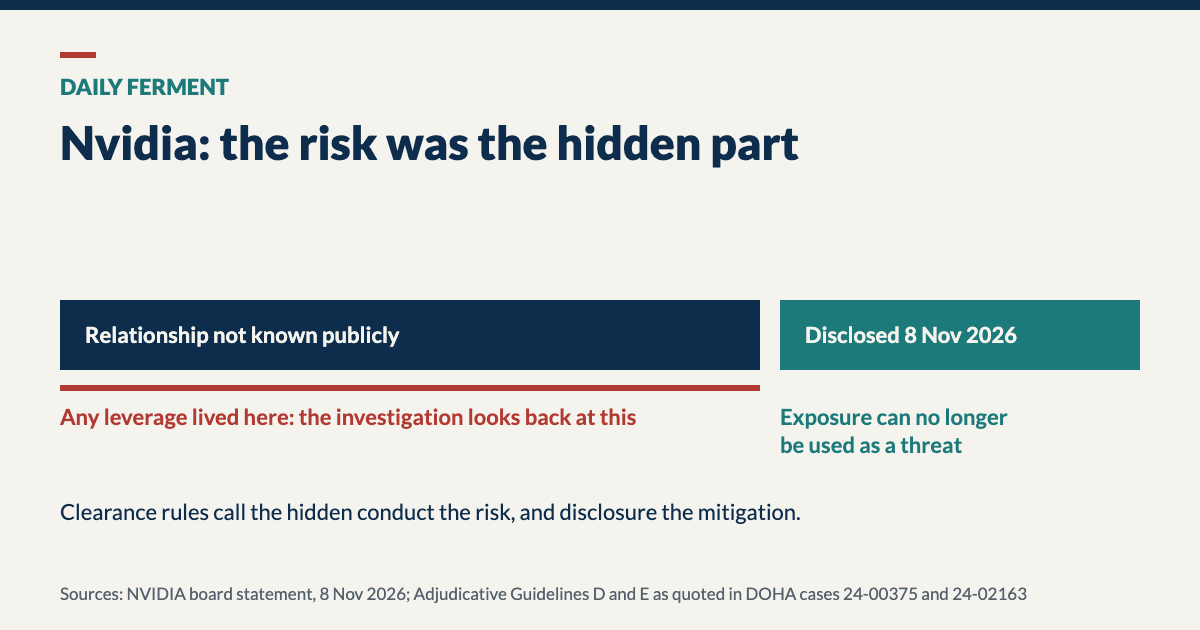
NVIDIA Board of Directors, 8 November 2026Read through that lens, Huang's email is not only an apology. It is the step the clearance rules treat as mitigation. A secret that its owner has told the world can't be used to threaten him with exposure any more. If anyone held that threat, it ended on 8 November.
That's the part that made me drop my first reaction. But it also shows exactly what the board still has to answer. The lever, if there was one, existed during the time the relationship was not known. Disclosure closes the future risk. It says nothing about the past. So the useful questions for the committee are about that period: who had access to what, which conversations happened, and whether any decision looked different from how it would otherwise have looked. That's an investigation into who knew what, and when. The marriage is his family's business.
What other boards can take from it
Most companies don't run anything like a clearance process for their CEO, and I don't think they should copy one. But the core idea travels. Boards already worry about depending on one person for strategy and relationships. When you judge that person's private conduct as a business risk, morality is the loudest axis and the least useful one. The useful question is whether something hidden gives an outsider a handle on a person who holds things the company can't afford to lose. That makes a boring, practical policy possible: tell the board early, before someone else can tell it for you.
For a leader who holds valuable secrets, an affair is a security risk mainly while it is hidden, so the question for Nvidia's board is what happened during the hidden period, not the private life itself.
- Established
- What the board's statement and Huang's email say; the guideline wording as quoted in two DoD hearing decisions.
- Inferred
- That clearance logic is the right lens for a company board, and that disclosure ends future leverage (it removes the threat of exposure, not every other kind of pressure).
- Still a guess
- What the investigation finds. Nothing I've read shows any foreign effort succeeded, or even happened.
More on Daily Ferment: Microsoft offered 60,000 people the same exit. Who takes it? and The UK will curb non-competes. Football shows where the restraint goes next.
Sources
- Statement from NVIDIA Board of Directors, NVIDIA Newsroom, 8 Nov 2026
- Nvidia says it's investigating whether CEO Jensen Huang was the target of a 'foreign intelligence effort', Business Insider via Yahoo Finance, 8 Nov 2026
- Megaspeed exec was recruited to spy on Nvidia CEO, according to US intelligence memo, TechCrunch, 7 Nov 2026
- Nvidia Investigates Chinese Spy Claims After CEO Jensen Huang Admits Affair, Newsweek, 8 Nov 2026
- Nvidia CEO Jensen Huang admits to an affair with a suspected Chinese spy, Tom's Hardware, 8 Nov 2026
- DOHA ISCR Case No. 24-00375, 16 May 2025 (quotes Guideline D)
- DOHA ISCR Case No. 24-02163, 10 Mar 2026 (quotes Guideline E)