Canada switched on instant payments without its big banks. A 1913 phone deal shows what that costs.
Canada's Real-Time Rail went live with eight members and no Big Six bank, and both ends of a payment must be on it. Brazil's Pix rule and a 1913 AT&T deal show what fixes that.

On Monday, 9 November 2026, Payments Canada switched on the Real-Time Rail, a national system that clears and settles payments in seconds, all day, every day. Most Canadians can't use it yet. It went live with eight participants, from Wealthsimple and KOHO to Bank of America, and none of the Big Six banks, which BetaKit's sources describe as settling most of the country's payments. Payments Canada's own FAQ says both the sending and the receiving institution must be enabled. So the answer to "can I use the Real-Time Rail?" is: only if your bank and the other person's bank are both on that list of eight. The government's stated aim is all major institutions by summer 2027.
The gap between "live" and "usable" is what caught my attention. It's an old network problem, and Brazil and the early American phone business both ran into it.
What actually launched on 9 November?
The Payments Canada release names the first cohort: Wealthsimple, Questbank, Peoples Trust Company, Paramount Commerce, KOHO, DoBusiness.com, Digital Commerce Bank and Bank of America. It says more participants "are expected to join in the coming months, including all major Canadian financial institutions." It also launches with fraud controls built in, including confirmation of payee for consumer accounts, which matters because, in the FAQ's words, RTR payments "are final and irrevocable, except in circumstances specified in the RTR Rules."
What the release doesn't say is whether joining is required. BetaKit reported on 8 October, from four unnamed sources, that none of the Big Six were scheduled for the first phase and that banks are "not currently required to participate." The timeline it published runs from launch in Q4 2026, to the first Interac e-Transfer participants in Q1 2027, to full capacity in Q3 2027.
The project is years late. BetaKit wrote in 2023 that delivery was first promised for 2022, and last week that it was first targeted for 2019. Either way, Canada has been building this since about 2015.
Sources: Payments Canada launch release (9 Nov 2026), RTR FAQ and system page; BetaKit, 8 Oct 2026.
- About 2015 Development begins (BetaKit)
- 2019, then 2022 Earlier target dates reported by BetaKit
- June 2023 Launch delayed again, risk review announced
- 8 Oct 2026 BetaKit: no Big Six bank scheduled for phase one
- 9 Nov 2026 RTR goes live with eight participants
- Q1 2027 First Interac e-Transfer participants planned
- Summer 2027 Government aim: all major institutions
- Q3 2027 Full capacity; over 9 in 10 accounts targeted
Sources: Payments Canada; BetaKit (5 Nov 2026, 8 Oct 2026, 13 Jun 2023).
My first reaction, and why I changed it
My first reaction was the one KOHO's founder Daniel Eberhard gave BetaKit in October: a rail that most of the country can't reach is close to performative. Launch day becomes a ribbon cutting.
Then I read the Canadian Bankers Association's line in the same piece: it "supports the multi-wave approach." That's a real argument. Instant payments can't be pulled back, and a system that fails in its first week with the biggest banks on it fails for everyone at once. Starting with small, newer institutions is how you test the plumbing on traffic that won't take the country down. I think that case is fair.
But it answers a different question. Phasing explains why the big banks aren't first. It doesn't explain what makes them arrive. And for a payment network, that second question decides almost everything.
Why does a payment rail need every bank on it?
Because a payment has two ends. A new rail with eight members can only move money between customers of those eight. If you bank with one of the Big Six and so does the person you're paying, Monday changed nothing for you. Your money still moves the old way. That's my reading of the participant list and the FAQ together, not something Payments Canada states in those words.
This is what economists call a network effect, and payment systems have it in its purest form. Each new member makes the network more useful to all the others, and each large holdout makes it less useful by a lot, because a large bank's customers are a large share of the people you'd want to pay.
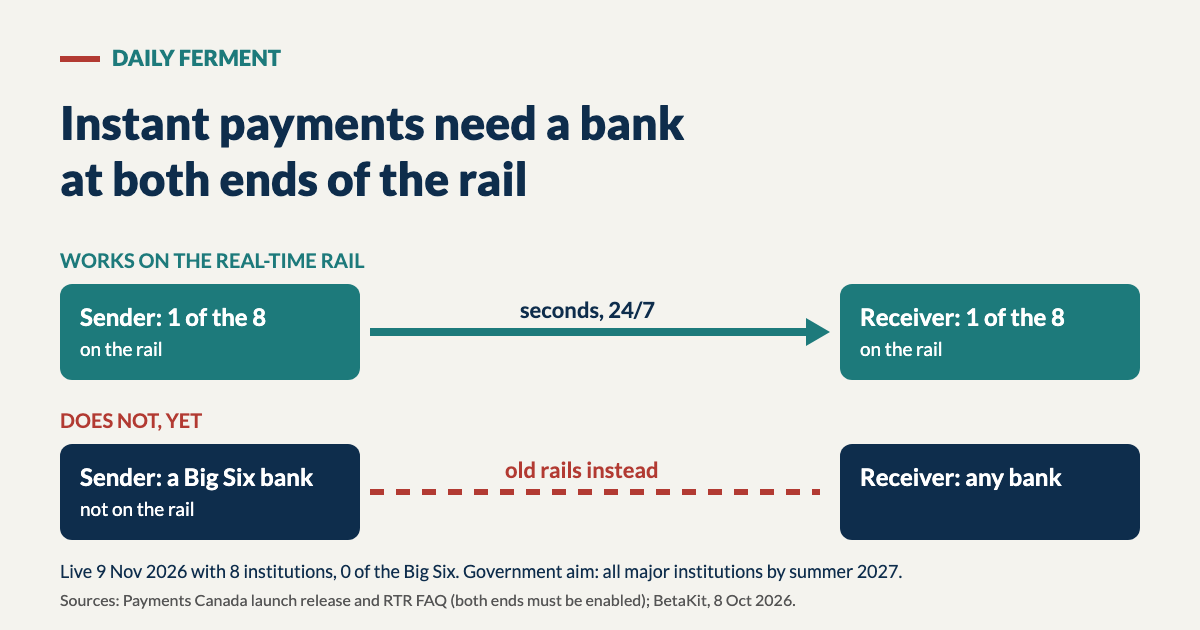
So for any country building one of these, the hard choice isn't technical. Do you wait for the large banks to arrive, or do you require them to join?
How did Brazil handle the same problem?
Brazil decided before launch. The Banco Central do Brasil's Pix regulation, Resolução BCB nº 1 of 12 August 2020, says in article 3 that participation in Pix "é obrigatória" (is mandatory) for financial and payment institutions with more than 500,000 active customer accounts. The large institutions didn't get a wave. They got a rule.
The detail I find telling came six years later. On 18 September 2026, Resolução BCB nº 587 ended that blanket obligation and moved to case by case exemptions. By then the mandate had done its work. The Rio Times reported a record 318 million Pix transactions on a single day, 4 September 2026. Brazil loosened the rule once the network was enormous, not before.
The 1913 deal that let small phone companies reach the network

The cross I keep coming back to is older, and it isn't about money at all.
In the early American telephone business, the Bell System had the best long distance network in the country and refused to connect it to independent carriers. Without long distance, many independents couldn't survive: a phone that can't call the next city is worth less every year. It took a federal investigation and the threat of an antitrust suit to change that. On 19 December 1913, AT&T vice president Nathan Kingsbury sent the letter now called the Kingsbury Commitment. AT&T agreed to sell Western Union, to give independent exchanges long distance service under conditions, and to stop buying up rivals if the Interstate Commerce Commission objected. In return the government didn't sue.
US telephones, 1913
- Who held the network Bell System long distance lines
- Who was left out Independent local carriers
- What made them connect Antitrust threat, then the Kingsbury Commitment
Brazil Pix, 2020 and Canada RTR, 2026
- Who holds the customers The largest banks
- Brazil Joining required by rule above 500,000 accounts; loosened in Sept 2026
- Canada Phased waves; government aims for all major institutions by summer 2027
Sources: Kingsbury Commitment (Wikipedia); Resolução BCB nº 1 (2020), art. 3; Rio Times on Resolução BCB nº 587; Payments Canada; BetaKit, 8 Oct 2026.
The deal had limits. It didn't force local interconnection, and AT&T kept control of the most profitable markets. But it established the point that matters here: when the value of a network depends on who can reach whom, the party holding the most connections decides how fast it grows, and it rarely decides "now" on its own.
Canada's situation is softer. The big banks aren't refusing; they're scheduled. The government says it will "work to have all major financial institutions participate" by summer 2027. That is a target, not a rule.
What would tell us which way this goes?
Two dates are worth watching. The first Interac e-Transfer participants are planned for Q1 2027, and Payments Canada says it is targeting more than nine in ten Canadian bank accounts by Q3 2027. If the big banks join on that schedule, the phased approach was right and the launch-day criticism was just impatience. If the dates slide the way the launch did, the Brazilian answer, a membership rule with a threshold, is sitting there to copy.
It also matters well beyond Canada. Every country building an instant payment system makes this choice, often without saying so out loud. New England's banks faced a version of it in the 1820s, when par for banknotes depended on banks agreeing to settle through one place. And the same pull between incumbents and newcomers shows up whenever switching gets cheaper for customers: the institutions with the most to lose are the ones that set the pace.
A real-time payment network is only as instant as the largest bank that hasn't joined it, which is why Brazil wrote Pix membership into its rules and Canada's Real-Time Rail went live with eight members and none of the Big Six.
How sure am I?
- Established
- The eight launch participants and the rule that both institutions must be enabled (Payments Canada, 9 November 2026); Brazil's 2020 Pix mandate above 500,000 accounts and its loosening on 18 September 2026; the terms of the 1913 Kingsbury Commitment.
- Inferred
- That most everyday payments in Canada can't use the rail yet. It follows from the participant list and the both-ends rule, but Payments Canada hasn't published usage.
- Guess
- Whether Canada will end up needing a membership deadline in law. Why the Big Six aren't in the first wave isn't public beyond "multi-wave", and I haven't assumed a motive.
Everything here is read from published sources, not tested firsthand.
More on Daily Ferment: Singapore says a stablecoin's par is not a given. New England made it one in 1825. and Stripe made OUSD the default. Who pays you to hold it?
Sources
- Payments Canada, Canada launches the Real-Time Rail, bringing 24/7 payment infrastructure to the national economy, 9 November 2026.
- Payments Canada, Real-Time Rail frequently asked questions, read 10 November 2026.
- Payments Canada, Real-Time Rail payment system, read 10 November 2026.
- Madison McLauchlan, Canada's initial real-time rail rollout likely won't include big banks, sources say, BetaKit, 8 October 2026.
- BetaKit, Real-Time Rail payments system to launch Monday, feds say, 5 November 2026.
- BetaKit, Rollout of Canada's Real-Time Rail payment system delayed again, 13 June 2023.
- Banco Central do Brasil, Resolução BCB nº 1, 12 August 2020, art. 3 (as reproduced by Normas Legais).
- The Rio Times, report on Resolução BCB nº 587 and the 500,000 account rule, 18 September 2026.
- Wikipedia, Kingsbury Commitment, read 10 November 2026.